
The 2026 NASCAR season is well underway, but are you prepared?
Whether you’re new here or just looking for a refresh, you’re in the right place! This is the ‘Rookies’ guide to NASCAR to make sure you’re ‘in the know’ for this season of racing.
What is NASCAR?
“NASCAR”, or, “The National Association for Stock Car Auto Racing” was founded in 1948 by Bill France, Sr. The term “stock car” is derived from the practice of taking show room cars and modifying them for racing.
There are eight current national touring series under the leadership and operational control of NASCAR, but the top three are the Craftsman Truck Series, the O’Reilly Series (formerly known as the Xfinity Series), and the premier division, The NASCAR Cup Series.
The Car/Schedule
NASCAR’s race cars, known as a “Stock Car” not “A NASCAR”, have gone through several distinct eras, of which, we are currently in the 7th Generation known as “The Next-Gen Car”. It was a radical departure for NASCAR, exchanging cars fabricated from the ground up by race teams – for kit cars, built from single-source supplier parts. Like any new manufacturing endeavor, there were setbacks along the way. Thankfully, part and assembly quality have greatly improved, along with continued safety improvements that have made this generation of cars one of the safest in Cup series history.
NASCAR utilizes three main race packages for the Cup Series, one for the “Superspeedway Tracks” (otherwise known as Plate Tracks),more specifically Talladega and Daytona. The next one is for the Intermediate races like Charlotte and Kansas. Finally, NASCAR has a race package, and one known as the short track and road course package. There are some caveats for that one though, as the package is run at several tracks over a mile in length, like Darlington and Dover.
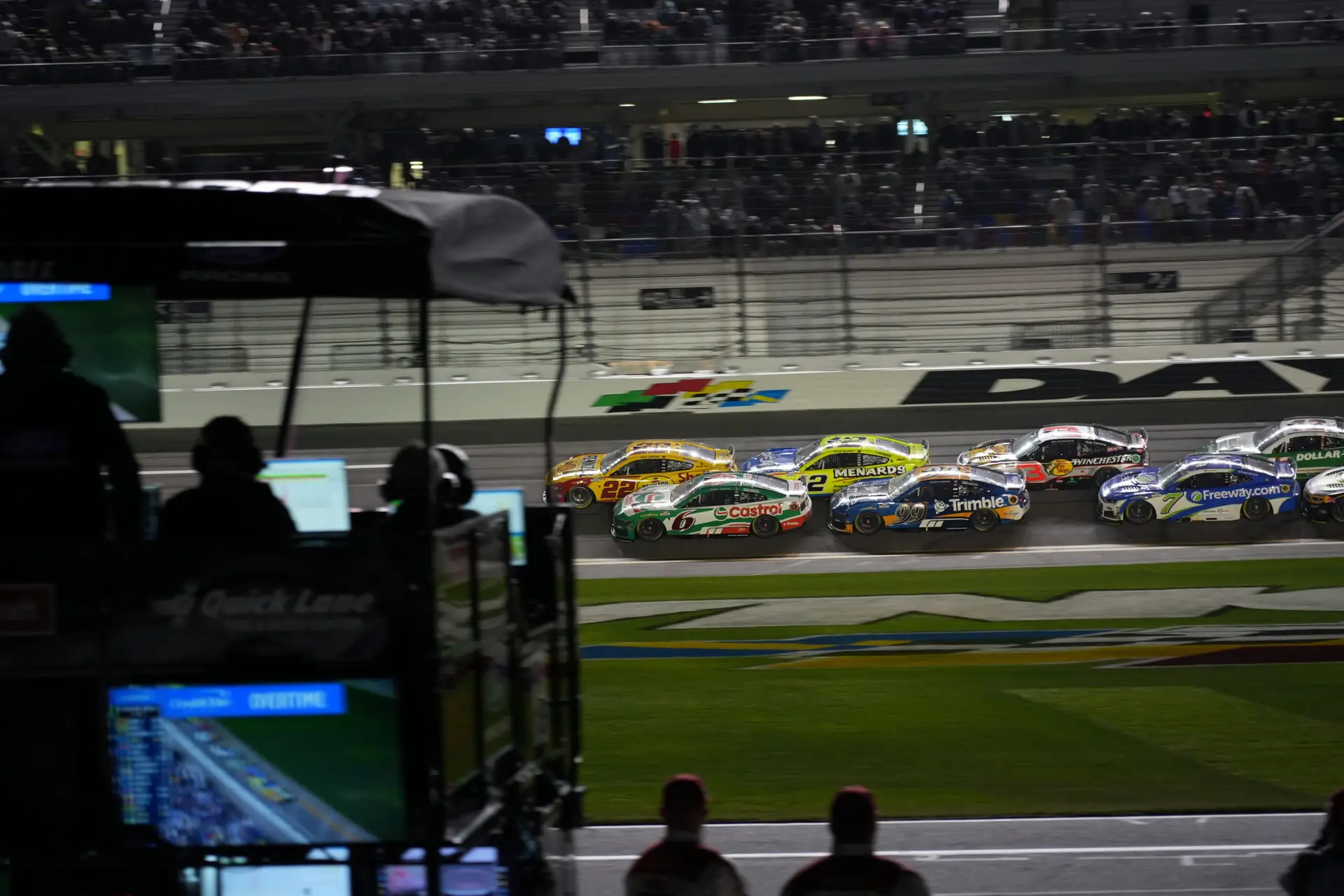
Historically known as “Plate Racing”, the Superspeedway package is what is run at Daytona, Talladega, and ever since the reconfiguration in 2022 at EchoPark Speedway. Due to the speeds and incidents getting out of hand in the 1980s, the power is reduced to 510 H.P. and the drag increased resulting in the vehicles grouping together in a pack and drafting off of each other for the duration of the event. This close tight knit racing usually causes large wrecks which will dominate the highlight reels.
At the intermediate tracks, the horsepower increases to 670 H.P. and the drag is lowered, decreasing but not eliminating the power of the draft. There is still a large amount of on-throttle time, but not nearly as much as with the actual “drafting package”. This is for tracks between 1.5-2.5 miles that don’t utilize the super speedway package.
The “short track and road course package” is for all of the road courses and any oval less than 1.5 miles, the smallest of these being Bowman Gray Stadium at a miniscule quarter-mile and the biggest being Darlington Raceway at 1.36 miles in length. For 2026, the power increases, this time to 750 H.P. along with the removal of the undertray of the horseless carriages in an attempt to lower the downforce as much as possible. Over the last season Goodyear has been on a crusade to soften the tires as much as possible in an attempt to make the racing more entertaining by bringing back more strategic pit strategies and long term tire conservation by drivers. These changes were sparked by the largely lackluster racing product on short tracks and road courses over the past few seasons.
Charters
Back in 2016 NASCAR introduced the Charter system, a quasi franchise system designed to give the teams more intrinsic value. However, there was one major flaw in the system, they weren’t permanent. NASCAR intertwined them with the current TV deal of the time, and then their existence would be re-negotiated.
In 2024, with the deal set to expire at season’s end, the teams as a collective attempted to negotiate for permanence as well as a bigger piece of the pie. These negotiations stalled over the summer, and in September, NASCAR presented the teams with a final, last chance offer, and gave them 12 hours to sign. The vast majority of teams gave in and reluctantly signed the new agreement because, quite frankly, they couldn’t afford not to, although they were none too pleased about doing so. However,there were two teams that decided to go against the status quo, 23XI Racing and Front Row Motorsports. They did not sign and shocked the world by filing a lawsuit against NASCAR claiming them to be a monopoly.
Over the next year the lawsuit got ugly, and the overall outlook seemed rather grim heading into and during the trial. But, a settlement was finally reached between the parties, and the teams got their charter solidified, along with a fairer deal for all chartered teams for 2026 and onward.
So, with all of that said, what exactly is a charter and what does it do for you?
For competition purposes, a charter’s primary function is to guarantee you admittance in the proverbial ferris wheel ride every given Sunday. Outside of the competitive aspect, the Charter outlines the payment pool, outlines the cost cap, and a whole bunch of legal stuff that I’m not going to subject you to here.
So, yeah, basically, if you spend an exorbitant amount of cash to acquire one of these Charters, we’re talking $+40 M as of 2025, you get in every race guaranteed, and get your base prize money set for sure.
Practice & Qualifying
Weather permitting, every NASCAR weekend (with one major exception) begins with practice and then qualifying. Going into practice, teams are split into ‘A’ and ‘B’ groups based on their performance metric scores. Each group will then get a 25 minute session, and then they’ll qualify in these same groupings. For non-drafting ovals larger than a mile, each car will get 1 lap. They will get 2 at the tracks less than a mile. For road courses, each group will get a 20 minute qualifying session.
Exceptions to the 25 minute practice sessions will include the race at Naval Base Coronado, the return to Chicagoland Speedway after a 7 year hiatus, the Daytona 500 and traditionally the season finale event, which this year is Homestead-Miami Speedway.
Speaking of the Daytona 500, for it, the starting field is set in a unique way. Practice opens on Wednesday of race week, it will be a 50 minute session in the morning. That evening, we will have qualifying. The results of this qualifying will set the starting order for the Bluegreen Vacations Duels held on Thursday night. The odd numbered qualifiers reside in race 1 and will set the inside starting lineup. While the even numbered qualifiers in race 2, setting the outside line for the Daytona 500.
Barring the need to go to a backup car, the top-2 qualifiers have their spots locked in based on qualifying. They are free to start their Duel race and retire the car. You likely won’t see that though, because the races do pay points for the top-10 finishers in each. The winners will receive 10 points, with the distribution decreasing by 1 point per position down to 10th place.
For the unchartered cars, there are four available spots and they are the main focus for the Daytona Duels. However, the ‘Open Exemption Provisional’ which is an additional spot allotted by NASCAR specifically for drivers with previously attained impressive racing credentials. This was used in last season’s Daytona 500 by 4-time Indianapolis 500 Champion Hélio Castroneves.
Pit Stops
NASCAR races tend to be quite long, upwards of 600 miles, and can go even longer if the race “requires” overtime, so one tank of fuel and one set of tires aren’t going to cut it. That’s why each team has their own crew dedicated to this very conundrum. The pit crew consists of a front and rear tire changer, a tire carrier, a jack man, and a fueler. The jack man will lift the car one side at a time with a hydraulic jack specifically designed for this task, while the tire carrier brings the tires over the wall and to the side that’s being operated on. The tire changers will then replace the tires with a specialized gun that NASCAR issues all of the teams all while the fueler carries the nearly 100lb (full) over to fill as much of the tank as possible in usually less than 12 seconds.
Stage Racing/Overtime
For the first 68 years of NASCAR racing, races would drop the green flag on the field and only throw a caution when there was a danger on the track (or a piece of debris that TV could seldom find). In 2017, NASCAR decided that a change was needed. Stage racing was added in order to spice it up.
Currently, races are divided into three stages. A caution flag is displayed at the end of the first two stages and the checkered flag at the conclusion of the third.
Points are awarded to the top-10 finishers in each stage, 10 are awarded to the winner and then descending 1 point for each spot down to 10th. Prior to this year it wasn’t unheard of for the highest point scorer not to be the race winner. Primarily at drafting tracks and road courses. For the drafting tracks, it was usually due to the dominant car getting caught in a “big one” style wreck. For the road courses though, it has typically been caused by the race leader needing to pit before the end of the stage to maintain their track position.
Overtime will occur if a caution is thrown too close to the scheduled conclusion of the race, leaving no time to resume the race. Due to a handful of controversial finishes under caution in the mid 2000s, NASCAR began adding a 2 lap dash to the end of races that would have previously ended under the yellow. Originally, only one attempt was allowed, but that left its own complaints. Multiple adjustments later and we landed on “UNLIMITED ATTEMPTS” at an overtime restart, which has had its fair share of issues.
For an overtime attempt to be considered official, the leader must make it around the track once, taking the white flag and ensuring that there will be no more restarts. If the caution flag is displayed after the white, the race is official.
The Chase
NASCAR has utilized a plethora of championship deciding formats over the decades, systems based on race distance, purse payout etc. You name it, they’ve probably tried it at some point, but the longest lasting format of all was the full season points format. In 2004, that changed and it’s been a forever evolving piece of the NASCAR puzzle to see how we crown a season champion.
For the last 12 seasons, a win and you’re in, knockout multi-round elimination format ruled the landscape. It too went through an evolution after the 3rd year, but stayed the same for the last 9. This format was a mess, and it left the fanbase splintered.
The Chase For the Cup branding is back for the first time since 2016, but the actual formatting, while adjusted, is back for the first time since 2013. While winning an individual race may not lock you into a “Chase berth”, it does pay out 55 points now compared to 35 for finishing 2nd.
The first 26 races make up NASCAR’s “regular season”, and accumulating points is the name of the game. The top-16 points scorers will be granted access to the Chase, with the leader earning the “Regular Season Championship”. Everyone below 16th in the standings will still score points and be in the next 10 races, but they will no longer be eligible for the championship.
Those who do make it will have their points reset. The benefit of being the regular season champion is getting a 25 point cushion on 2nd and 100 points clear of 16th. From there, it’s pretty simple: whoever scoreth the most points is the champion.
Conclusion
That should be enough to get you started on the 2026 NASCAR season. Make sure to come back here for all of your post-race analysis, commentary and weekly news!
Written by: Seth Dolby
Watch the video version of this article: